The Weight of Early Decisions
Software has remarkable longevity. Code written decades ago continues to run on millions of systems today, carrying forward not just functionality but also design decisions—both good and bad. When we write software, we’re not just solving today’s problems. We’re making choices that will affect users for years, perhaps decades.
This is particularly true for foundational tools that become part of the Unix ecosystem. Once a command-line interface is established, changing it becomes extraordinarily difficult due to backward compatibility concerns, scripting dependencies, and the muscle memory of administrators worldwide.
A Case Study: crontab -e / -r key proximity
Consider the crontab command, a staple of Unix-like systems since its introduction with Seventh Edition Unix in 1979 and its formal specification in POSIX. This tool manages scheduled jobs, and for many system administrators, it’s a daily companion. The command has two critical flags:
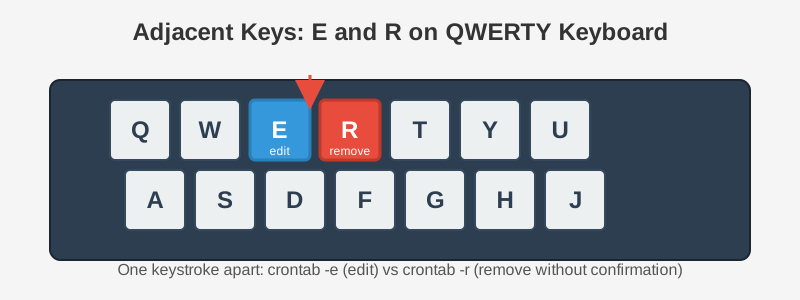
crontab -e- Edit your crontab filecrontab -r- Remove your crontab file without confirmation
These two operations couldn’t be more different in their consequences. One opens an editor for safe modification. The other instantly and irreversibly deletes the entire crontab file.
And on a QWERTY keyboard, the e and r keys are adjacent.
The Design Flaw Emerges
The proximity of these keys creates a dangerous failure mode. A simple typo—hitting r instead of e—transforms a routine editing operation into data loss. There’s no confirmation prompt, no undo, no backup. The crontab file is simply gone.
Given the ease of making this mistake, this will have affected any number of *nix administrators and users. Because the operation is not undoable work-arounds like system administration wrappers, manual backups or version-control management of the crontab directory are needed to protect potentially years of carefully crafted cronjobs could vanish with a single mistyped character.
The eventual fix (adding an optional -i argument) can be aliased for default usage but that still only protects the systems where it is configured; if a person comes to rely on that alias and logs into a new system where that has not been set up they could even more easily end up deleting a crontab by accident.
Also interesting from a design perspective is how long it took to address - and even then when addressed because backwards compatability was vital the problem remains to this day and is unlikely ever to be changed to default to a safer default behaviour.
It’s worth noting that while the crontab behaviour is arguably in line with the usual Unix Philosophy of doing what you asked (eg. there is no “trash can” for rm) this case study is more about the implications of the UX decision which placed “remove” and “edit” so close to each other in terms of a keystroke typo. People who have made this mistake may not even realise it - type crontab -r by mistake and silently delete your crontab and the confused crontab -e to discover no crontab there!
The Long Road to a Fix
Initial Bug Report (2001)
Searching back - reporter Enrico Zini filed Debian Bug #117758, clearly articulating the problem:
“crontab -r should ask for confirmation when run interactive. This can prove smart, especially since ’e’ and ‘r’ are next to each other in most keyboards, and the operation is not undoable in most file systems.”
Zini reported accidentally deleting an important crontab file without a backup. The issue was acknowledged, but not immediately addressed.
Additional Reports (2007)
Six years later, Tim Connors filed Bug #414048, again raising concerns about accidental deletion due to adjacent keys. Contributors Dmitriy Sirant and Dmitry E. Oboukhov proposed a solution: adding a -i flag for confirmation prompts.
This approach maintained backward compatibility while allowing users to alias crontab to use the safer behavior if desired—similar to how many users alias rm to rm -i.
The Fix (2008)
Finally, on January 8, 2008—21 years after the widespread adoption of cron in its modern form, and 7 years after the first documented bug report—the fix was implemented in cron 3.0pl1-101 by maintainer Javier Fernandez-Sanguino Peña.
The changelog entry reads:
“Add an option to ask for confirmation when a crontab is to be removed, based on Fedora’s patch for this same request. Users wanting this behaviour have to alias cron (just as rm is aliased to ‘rm -i’)”
Why It Took So Long
The delay in addressing this issue reveals several important constraints in Unix software development:
POSIX Compliance: The POSIX specification for crontab defines -r as “Remove the invoking user’s crontab entry” with no mention of confirmation requirements. Changing this default behavior would break POSIX compliance.
Backward Compatibility: An unknowable number of open and proprietary system automation tools, scripts, and workflows depend on crontab -r executing immediately without prompting. Changing this behavior by default would break these automations.
Unix Philosophy: The Unix philosophy favors executing commands exactly as specified, without second-guessing the user. This philosophy inherits from System V cron and pervades Unix-like systems.
These are not trivial concerns. They represent genuine design principles and compatibility requirements that serve important purposes. But they also demonstrate how early design decisions create lasting constraints.
The Compromise Solution
The implemented fix represents a carefully balanced compromise:
- Optional behavior: Confirmation prompts are available via the
-iflag but not enabled by default - User choice: System administrators can alias the command to include
-iif they want safer behavior - Backward compatibility: Existing scripts and automation continue to work unchanged
- POSIX compliance: The default behavior remains compliant with the specification
This solution doesn’t eliminate the hazard—it merely makes it possible for users to protect themselves if they choose to do so. The dangerous default behavior remains unchanged.
Lessons for Software Design
This case study illustrates several important principles:
1. Interface decisions have extraordinary persistence
The choice to use -r for a destructive operation without confirmation seemed reasonable in the context of 1970s Unix systems. But that decision has persisted for over four decades, affecting vast numbers of of users.
2. Proximity matters in physical interfaces
The placement of e and r as adjacent keys on QWERTY keyboards creates a failure mode that wouldn’t exist with different key choices. Physical interfaces constrain software design in ways that aren’t always obvious during initial development.
3. Defaults encode values
The default behavior of crontab -r encodes a value judgment: efficiency and scriptability are more important than safety. This made sense in an era of expert Unix administrators but became problematic as the user base expanded.
4. Backward compatibility is both essential and constraining
The need to maintain compatibility with existing scripts and automation is legitimate and important. But it also means that early design flaws can persist indefinitely, with fixes limited to optional behaviors that users must actively choose.
5. Standards create permanence
Once a behavior is codified in a standard like POSIX, changing it becomes vastly more difficult. This argues for careful consideration during the standardization process.
What Could Have Been Different
With the benefit of hindsight, several alternative designs might have reduced this hazard:
Different flag letters: Using non-adjacent keys for edit and remove operations (preferably taking into account different common keyboard layouts).
Consistent confirmation patterns: Following the pattern established by rm -i from the beginning
Safer defaults with override flags: Making confirmation the default with a --force flag for scripted operations
Each of these approaches has trade-offs. But they illustrate that the chosen design wasn’t inevitable—it was one option among many.
Conclusion
When we design software interfaces—particularly command-line tools, APIs, or protocols that might become widely adopted—we’re making decisions that could affect users for decades. The crontab -r case demonstrates how a seemingly minor interface choice, combined with keyboard layout realities, created a persistent hazard that took 21 years to partially address.
This argues for several practices in software design:
- Consider the physical and cognitive context in which interfaces will be used
- Think carefully about destructive operations and their safeguards
- Recognize that defaults encode values and will persist
- Balance efficiency with safety, especially for irreversible operations
- Document design decisions and their rationales for future maintainers
The code we write today may still be running well beyond our expected time-frames! The interfaces we design now may constrain solutions for decades. That’s both a sobering responsibility and an opportunity to make thoughtful choices that serve users well into the future.
The crontab -r story reminds us that in software, as in architecture, we shape our tools and thereafter our tools shape us. Choose wisely.
References
- Debian Bug #117758 - Original report: “crontab -r should ask for confirmation”
- Debian Bug #414048 - Follow-up report with proposed solutions
- Ubuntu Launchpad Bug #1451286 - Related discussion
- Debian cron changelog 3.0pl1-137 - Implementation details
- POSIX crontab specification - Official standard